
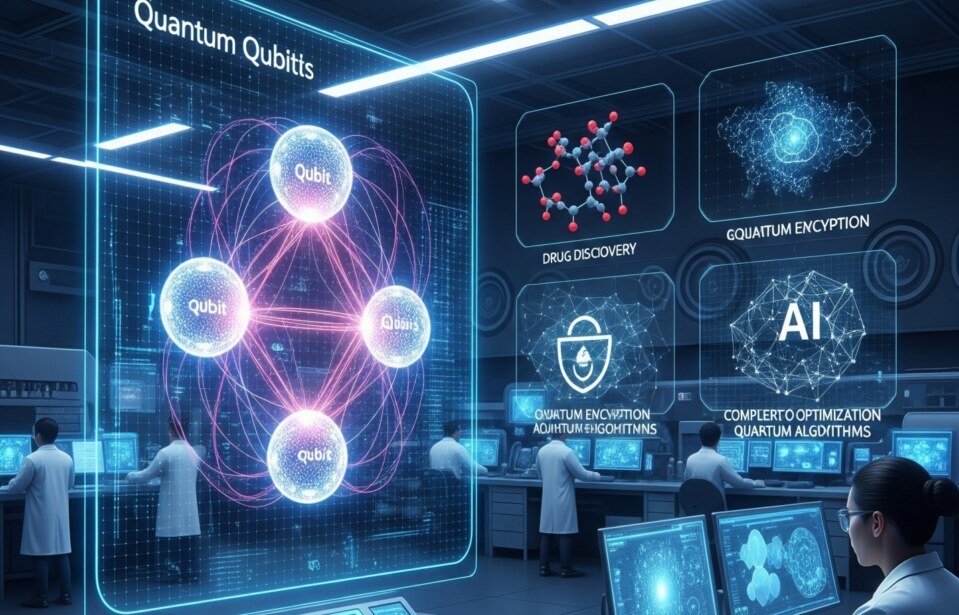
Modern computers have enabled massive breakthroughs in computation, data storage, and global communications. However, classical silicon chips, which represent data as binary bits (0s and 1s), face physical limitations when solving highly complex calculations. To process calculations beyond the capabilities of supercomputers, researchers are developing quantum computing systems. These machines leverage quantum mechanics to process information in a fundamentally different way.
In this guide, we will explain the physical principles of quantum computing, detail the core building blocks (like qubits), outline real-world applications, and compare classical vs. quantum paradigms in a table.
The Core Building Blocks of Quantum Computation
Quantum computers process information by manipulating subatomic particles using three principles of quantum mechanics:
1. Qubits (Quantum Bits)
Unlike a classical bit that must be either 0 or 1, a qubit represents a physical quantum system (like a trapped ion or superconducting loop) that can exist in a combination of states.
2. Superposition
Superposition allows a qubit to exist in a linear combination of both 0 and 1 states simultaneously. A system with \(N\) qubits can represent \(2^N\) states concurrently, enabling parallel computation on a scale impossible for classical computers.
3. Entanglement
Quantum entanglement links the states of two or more qubits. Once entangled, changing the state of one qubit instantly affects the state of the other, regardless of distance, allowing qubits to share information rapidly during calculations.
Classical vs. Quantum Computing
Refer to this table to compare the core characteristics of classical and quantum computing systems:
| Characteristic | Classical Computing | Quantum Computing |
|---|---|---|
| Basic Unit of Information | Bit (0 or 1) | Qubit (Superposition of 0 and 1) |
| Operating Temperature | Standard Room Temperature (300K) | Near Absolute Zero (0.015 Kelvin) to maintain state stability |
| Algorithmic Logic | Boolean Algebra (AND, OR, NOT gates) | Quantum Gates (Hadamard, CNOT) & wave interference |
| Primary Application Areas | Database queries, streaming, general software execution | Cryptographic analysis, molecular simulations, logistics optimization |
Real-World Applications
Quantum computers are not general-purpose replacements for personal laptops; instead, they are designed to solve specific, highly complex mathematical problems:
- Applied Cryptography: Running Shor’s Algorithm can factor large prime numbers in minutes, creating a need for post-quantum cryptographic standards to protect encrypted communication.
- Molecular Modeling: Simulating molecular interactions at the atomic level, accelerating drug discovery and the development of new materials.
Summary
In conclusion, **quantum computing** represents a major shift in computational power, utilizing quantum mechanics to solve problems that are currently unsolvable. As research continues to improve qubit stability, these systems will play an increasingly important role in science and security. To see how these calculations impact modern encryption protocols, read our guide on IP security in cryptography. For tutorials, programming libraries, and cloud access to quantum systems, visit the IBM Quantum Resource Center.


Leave a comment