
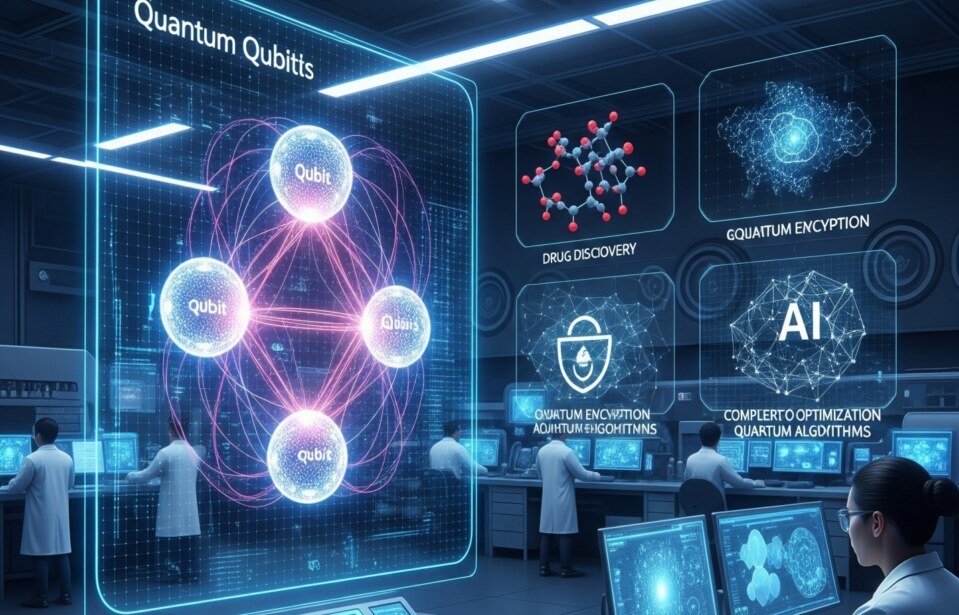
When one mentions quantum computing, visions of complicated formulas, high-tech laboratories, and very resourceful physicists come into mind. It is all that sounds like something that the academic elite or the science fiction pages would be reserved to see. When at its base it is amazingly complicated, the revolutionary prospects of quantum computing do not entail the need to go deep into quantum mechanics.
You can see it more of a creation of the engine, and more of wondering how incredible the journey in a vehicle can be. Quantum computing will not take over your smartphone or laptop in day-to-day uses. It is not, however, a new paradigm at all, but a brand new one that holds the potential to address the issues that are as yet considered too complex to be solved even by the most powerful supercomputers in the world.
Anyway, time to unravel the next mystery, no necessity to have a degree in physics!
The Building Blocks: More than 0s and 1s
What happens to be core of quantum computing is that there exists a stark contrast between quantum and classical computing.
- Classical Computers (your kind): are bit-based. A bit is similar to a light switch i.e. it can always be ON (1) or OFF (0). These states of information are utilized in order to process information sequentially.
- Quantum Computers: The utilization of qubits. That is where the interesting stuff happens, courtesy of the weird laws of quantum mechanics:
- Superposition: Up to the moment you observe it, that light switch cannot be just ON or just OFF, it might be both ON and OFF. That’s superposition. A qubit would be in a mixture of 0 and 1. It implies that an individual qubit can contain exponentially more information than a classical bit and a system of qubits can simultaneously investigate exponentially many possibilities.
- Entanglement: It is possibly the most mystical concept. When two or more qubits are so-called entangled, then they become associated with each other in such a manner so that the condition of one of them would immediately or immediately impact the condition of the rest. Regardless of the distance between them. What you learn when you measure one entangled qubit instantly is the state of its partner qubit (or qubits). This connectedness enables quantum computers to provide operations that cannot be carried out by classical machines.
- Quantum Interference: In the same way that waves are able to interfere (positively or destructively), quantum states can also interfere. Quantum algorithms make use of this property to exaggerate correct solutions and negate wrong ones, making it more likely a correct solution can be found when the qubits are at last measured.
Such unusual and yet very strong properties make quantum computers capable of working with immense information volumes and solving some particular issues much faster and efficiently compared to traditional computers.
What makes it Revolutionary? Real-World Applications
Then what problems could quantum computers solve that are not solvable using a classical one? These are some of the areas where quantum computing is likely to be groundbreaking:
- Drug Discovery & Materials Science: The correlation of molecular interplay is extremely intricate. Even simple molecules are not well modeled by classical computers. Quantum computers could represent the molecules, which are quantum in nature and hence mimic their behavior and it is possible that a complex chemistry reaction could be simulated accurately. This would result in the discovery of new drugs, more practical catalysts, as well as new materials having property customized (e.g. in improved batteries or even superconductivity).
- Cryptography and Cybersecurity: Some modern cryptographic protocols base themselves on the measure of the difficulty to factor a big number and this is one of the tasks which could take thousands or billions of years with using classical computers. These numbers might be factorized using a quantum algorithm (Shor’s algorithm) in vastly reduced time and this could be used to break many current encryptions. This is causing futuristic rush to establish quantum-resistant cryptography of our digital future.
- Optimization Problems: Real life is full of engineering, logistic and supply chain issues, financial modeling problems and traffic flow problems where you have to search the set of all those possible solutions to find the optimal one. Quantum computers would be able to optimize delivery services, production or investment portfolios a lot more effectively.
- Artificial Intelligence and Machine Learning: Quantum computers promise to turbocharge machine learning to analyze tremendously large data and find patterns that few conventional algorithms can see, resulting in stronger AI, including improved forecasting models and new knowledge in everything.
- Climate Modeling: The climate systems are complex to simulate and demand enormous power. Quantum computers would be able to design more precise and in time precise climate models and thus help us in climate change and anticipation of extreme weather conditions.
The Current Status: A Journey, Not a Destination (not Yet)
One should establish expectations. The field of quantum computing remains to be immature. We have not yet reached the stage at which some kind of use of quantum computers can be used to perform standard, everyday tasks better than the classical computers can.
Challenges include:
- Qubit Stability (Decoherence): Qubits are very fragile. A quantum system is quite vulnerable: even such minor environmental perturbations (such as heat (or electromagnetic fields)) can cause them to lose their quantum properties, a phenomenon known as decoherence. The one big challenge is the ability to keep qubits stable long enough to carry out complex calculations.
- Error Correction: Quantum computers are easily affected by errors. It is very challenging and very important to construct good quantum error correction methods in order to construct fault-tolerant quantum computers with reliability.
- Scalability: The problem is that constructing quantum computers containing hundreds, thousands, or even millions of stable, connected-to-each-other, qubits is an enormous engineering problem.
Nevertheless, this is moving at a fast pace. Leading tech companies such as IBM, Google Quantum AI, Microsoft (Azure Quantum), Amazon (Amazon Braket), along with more-specialized firms like IonQ and D-Wave Systems, are investing large sums of money in hardware development (using, in most cases, quantum computing hardware consisting of superconducting quantum transistors (SQT), combined with superconducting qubits), as are various research centers in universities around the world.
Such technologies as superconducting circuits, trapped ions, and neutral atoms) and development of quantum software. We have witnessed cases of so-called quantum supremacy, when quantum computers are able to overcome certain tasks in less time than all classical computers, which indicates the huge potential.
The Curiosity is the Key
It is not necessary to study all the complexity of quantum mechanics to realize the power with which quantum computers can have. The thing is to remember that something extremely new in information processing occurs, which can solve one of the important problems of humanity.
What really matters is remaining inquisitive, tracking of the breakthroughs and how they could be utilized. The quantum era is coming, and its rays will illuminate all our future.


Leave a comment