
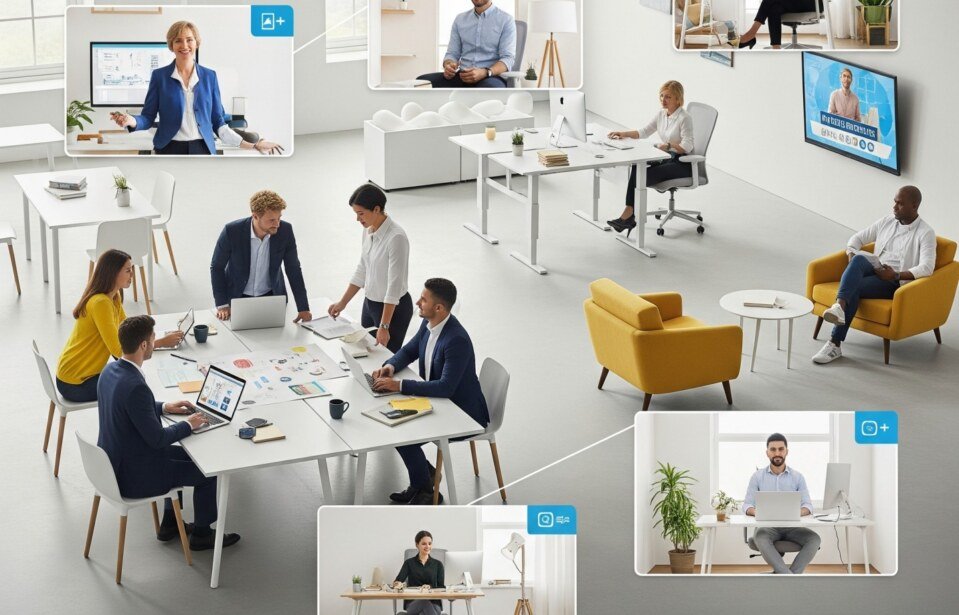
The current hot debate: is the conventional office a thing of the past? On the one hand, the headlines in the media may convey the impression of its death, but on the contrary, the situation is more complex. It is not the death of the office but rather it is being transformed. We are deeply rooted in the epoch of hybrid work, the model which combines remote labour and working at the office, and every indication shows that it is here to stay and will become the new default paradigm.
The change, once involuntary with the impact of a global pandemic, has now evolved to be a strategic move on the part of businesses and something that is non-negotiable by a vast number of the working population. The knowledge on why hybrid work is here to stay and more importantly how to make it work is a priority to the success of organizations in 2025 and the future.
The reasons why Hybrid work is not going away
Hybrid transition is not just a short-term change, but rather a re-consideration regarding how, when and where work can be performed. There are some strong forces that are contributing to its survivability:
Big Employee Preference:
- Work-Life Balance and Flexibility: Employees have tried remote work-based flexibility (working fewer hours, choosing their own schedule, and cutting commute time) and are not ready to go back to the whole 9-to-5 office experience. A Gallup poll undertaken in February 2025 showed that 52 percent of employees in the U.S. who have remote capability are working in a hybrid setting today and a surprising 60 percent of them would like it to be how they work in the future. Fewer than 10 percent favor working in full location.
- Independence and Efficiency: Most people can attain cognitive self-control and high performance when working remotely without disturbances in the office. Such independence, Gallup says, can increase engagement, but it comes with its difficulty.
Increased Talents Pool and Talent Retention:
When provided with the hybrid or remote alternative, the company extends its talent search by far beyond geographical borders. It is the competitive advantage and it enables organizations to hire and retain the best workers who value flexibility.
In an April 2025 report, Robert Half discovered that almost half (48 percent ) of job seekers want a hybrid position, and 76 percent of employees have asserted that workplace flexibility regarding hours and location can affect their interest in remaining with the employer.
Greater productivity and well-being (Done properly):
Hybrid models when applied with sights set in the right direction may result in a higher level of employee satisfaction, engagement, or even productivity. The tendency of letting employees work remotely makes them arrive in the office more refreshed and focused on joint work.
McKinsey study shows that employees in hybrid mode have the same intentions of quitting, burnout, effort, and satisfaction as fully in-person workers and those fully working remote, thus showing no productivity shortfall.
Organizational Cost Saving:
Major organizations operating in the high cost urban areas will realize significant real estate, utilities, and office supplies savings by reducing the number of leased premises for physical offices.
Organizational Resilience:
The pandemic revealed the essentiality of operational flexibility. Hybrid models enshrine resiliency in the business, and it is easy to absorb changes, even those that are shocking to the business.
The Challenges: Finding Our Way Around Hybrid Work
Even though hybrid work is objectively a better option, it is not a panacea. It comes with complications that uncontrolled can parasitize its advantages:
- A Lot in Common: A sense of company culture and strong connections within the team may become difficult to achieve when people are not physically in one place. According to Gallup 2025 report, fully remote workers are very engaged yet, likely to be thriving in their lives overall, and similarly, they might become lonelier because of reduced interaction.
- Equity and Inclusion: It is a big challenge to make sure that remote and in-office workers have access to the same information, opportunities, and recognition (and lack of proximity bias where in-office employees are favored unintentionally).
- Effective Teamwork and Teamwork: Efficient teamwork and collaborative work demand to be carefully designed. Zoom fatigue is a reality and improperly regulated virtual meetings are less efficient than real-world ones.
- Management and Leadership skills: Management of the hybrid team would demand some other skills. Leaders should get out of the mode of management by presence and settle on management by outcomes where there is trust and giving autonomy.
- Technology and Infrastructure: Good infrastructure with stable virtual collaboration devices, safe access, and properly-equipped hybrid meeting rooms are not options.
Reinventing work: How to make hybrid work, work: Strategies for success
Enabling successful hybrid work has little to do with hard-and-fast rules, and everything to do with application (with creativity and flexibility and a commitment to goals).
Clarify effective policies and expectations:
Avoid ambiguity. Firms need to make their hybrid form explicit: e.g. three days in office, two days off-site, flexible preference or core days of collaboration.
As an example, the model of Google is rather inclined to get employees in the office three times weekly, where core days of collaboration are often implied. It is also a structured approach because they monitor the office attendance.
On the other hand, Microsoft will focus on flexibility with the sense that there is no such thing as a one size fits all in flexible work. They provide diverse work place solutions ( up to 50% WFH and up to 100% depending on the role WFH or on site only).
Make Office Efficient to Connect and Cooperate:
The office no longer becomes a generic place of work but a place to be. Set some office days when you can meet your team, brainstorm, have fun with clients, mentor others, and socialise.
According to the statement adopted by IBM, “the workplace is not just a place to be, it is a destination, more of a hub, where employees want to gather and work together, are safe and connected to one another.”
Invest Lots on Enabling Technology:
A physical distance is overcome with seamless collaboration tools (Microsoft Teams, Google Workspace, Slack, Zoom), excellent video conferencing equipment provided in meeting rooms, digital whiteboards, and powerful cloud infrastructure.
This is emphasized by Microsoft as they say that it is their digital first collaboration tools that keep an individual connected to their team no matter where they are.
Train Leaders and Empower Leaders:
Successful hybrid models are made up of managers. They will require learning how to manage distributed teams, build inclusion, have results-based performance management and enable productive virtual and face-to-face work.
To address the management issues of stress and burnout due to hybrid work, it is essential to empower managers and teach them to gain trust and empower their people, as Gallup research even indicates.
Instill a System of Trust, Empathy and Psychological Safety:
Hybrid work is a trust business. Companies should believe in employees, who control their own time, and provide results, no matter where they are. Employers are supposed to create a culture of empathetic leadership, where leaders can be well aware of the needs and difficulties.
According to McKinsey, collaboration within a certain model is not prioritized whether it is an individual model or a teamwork model; the effort owes its success to goal alignment, establishment and reduction of priorities and fit and connections between work post.
Place Some Emphasis on Equity and Inclusion:
Establish a set of practices that will make remote workers equally visible, develop their learning and access decision-making. This means giving voice to every person in hybrid meetings and making fair performance appraisals.
According to McKinsey research carried out in April 2022, the preference towards hybrid work is even stronger among traditionally underrepresented groups (e.g., employees with disabilities, nonbinary individuals, LGBQ+ employees, women, and Black employees), and they are more inclined to leave their employments without a hybrid working option. This supports the need of flexible work models in terms of diversity and inclusion.
Collect ongoing Reviews and Loop:
There is no perfect hybrid model it is sort of an experiment. Conduct surveys of the employees on regular basis, focus group gatherings and also analyze data such as office use, engagement and productivity to improve upon the policies and practices in use.
Transforming the Workplace, not Transforming the Office
The death of the office does not exist. It becomes a daily requirement to a strategic tool in an environment of adaptability. It is a conveying ground in innovation, collaboration, culture creation, and relation growth, whereas remote work brings the focus, adaptability, and geographical presence that the present-day talent needs.
The firms that will thrive in the hybrid will be the ones that will approach this change purposefully, invest in the right technologies and leadership, and put more emphasis on staff welfare and fair experiences. The tomorrows of work are already present, and they are firmly hybrid.


Leave a comment