
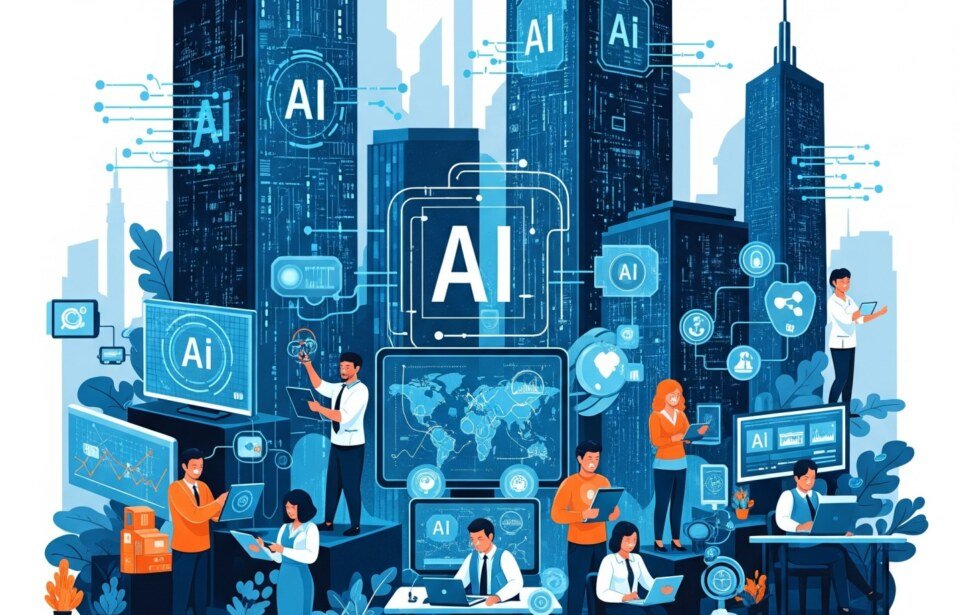
The news headlines continue to paint a stark picture: major tech companies, once symbols of unbridled growth and endless opportunity, are undergoing significant workforce reductions. In 2025 alone, over 100,000 tech jobs have been eliminated across giants like Microsoft, Google, Amazon, and Intel. While initial layoff waves in 2023 were often attributed to post-pandemic “overhiring” corrections, the current trend signals a more profound, structural shift in the industry.
This isn’t just a blip; it’s a re-calibration, largely fueled by the relentless advance of Artificial Intelligence and a renewed focus on efficiency. So, what’s really happening, and more importantly, how can professionals equip themselves to thrive in this evolving landscape?
The Shifting Sands: Reasons Behind the Recent Cuts
While no single reason fully explains the breadth of current layoffs, a confluence of factors is at play:
- AI-Driven Restructuring and Automation: This is perhaps the most significant and defining factor of the 2025 layoff wave. Companies are aggressively investing billions in AI, cloud infrastructure, and automation. To fund this, and to leverage AI for greater efficiency, roles that can be augmented or entirely automated are being streamlined.
- Microsoft, for example, confirmed significant cuts in July 2025 (around 9,100 employees), with CEO Satya Nadella emphasizing a “reorganize and invest in AI infrastructure” strategy, committing around $80 billion over the next few years. They are also removing layers of management and outsourcing more work.
- Amazon CEO Andy Jassy recently stated, “AI will inevitably lead to a reduction in certain job roles as tasks become automated,” while also emphasizing new opportunities in AI development. He advises staff to “be curious about AI, educate yourself, attend workshops and take trainings, use and experiment with AI whenever you can.”
- Salesforce CEO Marc Benioff noted that AI now handles up to 50% of the company’s work in critical areas like engineering, coding, and customer support, and Google CEO Sundar Pichai indicated over 30% of Google’s code is AI-generated. This “automation of automation,” as NVIDIA CEO Jensen Huang calls it, is fundamentally reshaping job functions.
- Economic Pressures & Cost Optimization:
- Rising interest rates and inflation have tightened budgets across industries. Companies are under immense pressure from investors to maintain profitability even if revenue growth slows. Layoffs are a direct way to reduce immediate costs and improve margins.
- Intel, for instance, is cutting a significant portion of its factory workforce (up to 20%, over 10,000 jobs) and shutting down its automotive chip division, citing “financial constraints and affordability goals” and a shift towards AI chips.
- Post-Pandemic Overhiring Correction: While not the sole driver anymore, the rapid expansion during the digital boom of the pandemic led some companies to overstaff. As demand for certain digital services normalized, a “right-sizing” became necessary.
- Strategic Business Realignments: Companies are divesting from less profitable or non-core business units to focus on strategic growth areas, particularly AI. This has impacted various departments, including gaming (e.g., Microsoft’s Xbox division cuts), niche product divisions (e.g., Google TV staff reductions), and specific regional offices.
The Analysis: A Structural Shift, Not Just a Cycle
This wave of layoffs isn’t merely a cyclical downturn. It’s a clear indicator of a structural transformation in the tech industry. The focus is now on:
- Efficiency: Leaner operations, removing management layers, and eliminating redundant roles.
- AI Integration: Prioritizing resources, talent, and investment into AI development and application across all functions.
- Skill Shift: A move away from roles easily automated or those not directly contributing to AI strategy, towards new, specialized, and highly technical AI-centric roles.
As Ginni Rometty, former CEO of IBM, famously put it, “AI will not replace humans, but those who use AI will replace those who don’t.” This encapsulates the challenge and the opportunity for the workforce.
Future-Proofing Your Career: Skills to Cultivate
The silver lining amidst the uncertainty is the clear roadmap for professional development. To navigate this AI-driven job market and minimize the risk of being laid off, focus on these critical areas:
- AI Literacy and Application:
- Understand AI’s Capabilities: You don’t need to be an AI engineer, but comprehending what AI can do (and cannot do) is crucial.
- Prompt Engineering: Learning how to effectively communicate with generative AI tools (like LLMs and image generators) to get desired outputs.
- AI Integration in Your Role: How can you use AI tools to enhance your current work, automate mundane tasks, and increase your efficiency? Whether you’re in marketing, HR, finance, or traditional software development, explore AI applications in your domain.
- Data Fluency: AI thrives on data. Skills in data analysis, interpretation, and visualization (e.g., Python, SQL, Power BI, Tableau) remain highly valuable.
- Cloud Computing Expertise:
- AI models are predominantly developed and deployed in the cloud. Proficiency in major cloud platforms (AWS, Azure, Google Cloud) is essential. Roles in cloud architecture, DevOps, and cloud security are highly in demand.
- Cybersecurity:
- As AI expands the attack surface for cyber threats, cybersecurity professionals with updated skills are more critical than ever. Knowledge of AI in threat detection and prevention is a huge plus.
- Deep Technical Specialization (with an AI Lens):
- While broad skills are good, deep expertise in specific, high-demand areas like MLOps, deep learning frameworks (e.g., TensorFlow, PyTorch), quantum computing, or ethical AI development will make you indispensable.
- “Human” Skills (The AI-Resilient Qualities):
- Critical Thinking & Problem-Solving: AI can provide answers, but humans are needed to ask the right questions, analyze complex problems, and devise creative solutions that AI cannot.
- Adaptability & Continuous Learning: The tech landscape is constantly changing. A growth mindset and a commitment to lifelong learning are paramount.
- Communication & Collaboration: The ability to articulate complex ideas, work effectively in diverse and often distributed teams (hybrid work!), and influence stakeholders.
- Creativity & Innovation: AI can generate, but human creativity remains the spark for truly novel ideas and artistic expression.
- Emotional Intelligence & Empathy: Skills crucial for leadership, client relations, and fostering a positive workplace culture.
A Call to Action for Every Professional
The recent layoffs are a sobering reminder that the job market is dynamic. However, they are also a powerful catalyst for growth and reinvention. As Amazon CEO Andy Jassy advised, “be curious about AI, educate yourself, attend workshops and take trainings, use and experiment with AI whenever you can.”
Don’t let the headlines paralyze you. Instead, use them as a wake-up call to assess your skillset, identify the gaps, and proactively invest in your continuous learning. The future of work is not about fearing AI, but about mastering how to work with it. Your ability to adapt, learn, and leverage these powerful new tools will be your greatest shield and your most valuable asset in the years to come.



Leave a comment